

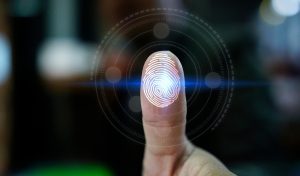
Fingerprint analysis is one of a number of components used in forensic investigation. It is one of the most accurate and common methods of identification in the world today, and can be lifted from a number of surfaces by forensic investigators – from paper to walls to human skin. Despite having been noted in the West as possibly a reliable method of identifying individuals – as far back as 1686 – it was officially employed only in 1892.
The case was that of Francis Rojas, an Argentinean woman who sought to place the blame of her own murder, and that of her two sons, on someone else. Yet leaving her bloody fingerprint on a door post, forensic investigators at the time concluded that Rojas was the murderer herself, and had killed her sons before slitting her own throat.
Prior to the adoption of fingerprint analysis and identification, the Bertillon system was used. It is a system which used measurements of body parts, especially the head and face, as a means of identification.
But the system was challenged in 1903 when two men were found to have almost the exact same measurements: Will West, and William West – both inmates at the same penitentiary in Leavenworth, Kansas. Indeed, according to the Bertillon system, they were the same person. What confused matters more was that they even looked alike, but did not admit any relation (but were found to be twins in a later investigation).
Fingerprint analysis subsequently identified them as two different people, and became a de facto method of identification.
How fingerprint analysis and identification works
A bloody fingerprint left on a door post, or any other surface where it may be visible to the naked eye, is what fingerprint analysts and forensic experts call a ‘patent’ fingerprint. Today patent fingerprints are collected by means of high resolution digital photography. Alternate light sources, dyes, and chemicals may be used during this process to enhance exposure.
Another type of fingerprint is the ‘latent’ print: invisible to the naked eye, yet not absent. Its discovery came much later in 1863, when Professor Paul-Jean Coulier of Val-de-Grâce in Paris published a method for fingerprint development using iodine fuming. Since then the technique of latent fingerprint development has evolved, and now includes fingerprint powder, some chemical agents, and alternate light sources.
Fingerprint classification
Prior to computerised filing systems, classification systems based on ridge formations were used to store and access fingerprints. Perhaps the most prominent among them was the Henry System of classification – developed in 1897 by Azizul Haque and Hem Chandra Bose, but named after their supervisor Edward Richard Henry. The system evolved over time and is still used widely today by forensic investigators and fingerprint analysts to correctly classify fingerprints for comparison with digitally-stored records.
Indeed, for the past 100 years fingerprint analysis has become our staple method of identification. It’s a much-celebrated technique, with many accounts of its famed history in Western literature, fiction, and more recently, on the internet. As an interesting aside, it is worth noting that, as with gunpowder, negative numbers, paper, and printing, the Chinese have relied fingerprints to sign documents for more than 3,000 years.



2 Responses
INTERESTING FACTS ABOUT FINGERPRINTS:
•You can outgrow your shoes but not your prints as they will stay the same no matter how old you are;
•In order to seal or close their business transactions, ancient Babylonians used fingerprints in their tablets;
•You can’t change or alter your fingerprints by cutting, burning or scraping them. Its pattern will remain the same as a new skin is developed;
•Experts say that an Egyptian mummy still has very clear fingerprints even if they were embalmed for a handful of years ago;
•Birds do have fingerprints. They are evident in their eggs that they law;
•Brothers Alfred and Albert Stratton of 1905 were the first victims of fingerprinting evidence. They were convicted of murder;
Very interesting and informative for me as a private investigator